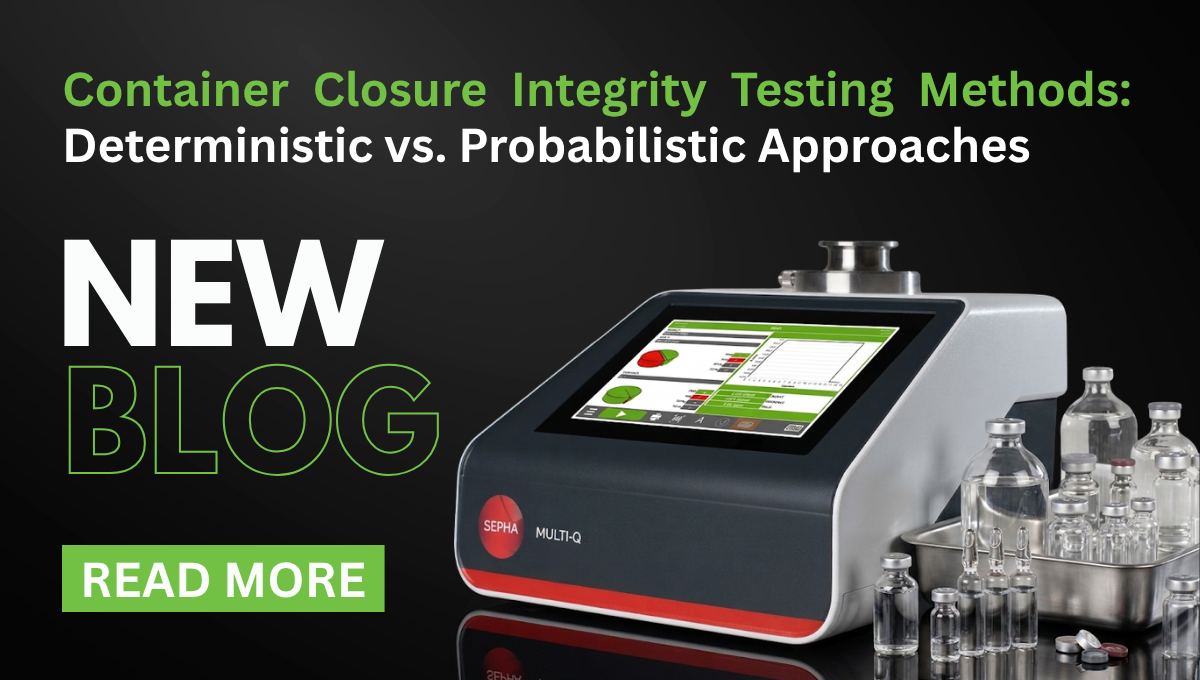
Container closure integrity testing (CCIT) verifies that a sealed package maintains its sterile barrier and protects product quality across its shelf life. For sterile pharmaceuticals, biologics, and medical devices, the container closure system is the last line of defense between the product and microbial contamination — so how integrity is tested, and how defensibly, has become a growing focus for regulators.
Guidance from USP <1207> and the FDA increasingly points manufacturers toward deterministic CCIT methods. These approaches detect leaks through direct physical measurement, over probabilistic methods that infer the likelihood of a leak. This guide explains the full range of CCIT methods, how USP <1207> and the FDA frame them, and how to choose an approach that stands up to audit.
A note on scope: WESTPAK performs CCIT by vacuum decay (ASTM F2338), a deterministic, non-destructive method. This article covers the broader range of CCIT methods for context; where a method falls outside WESTPAK’s services, that is noted so you can plan the right testing partner for each need.
Key Takeaways
- CCIT confirms a sealed package maintains its sterile barrier throughout shelf life; failures can compromise sterility and trigger recalls.
- USP <1207> splits leak-test methods into deterministic (direct physical measurement) and probabilistic (statistical inference), and prefers deterministic methods when the product–package system allows.
- The FDA does not mandate a specific method, but expects a scientifically justified, risk-based strategy — and increasingly asks why a deterministic method was not chosen.
- Vacuum decay (ASTM F2338) is a deterministic, non-destructive method suited to many rigid and flexible packages, including vials and prefilled syringes.
- Method selection should be risk-based and lifecycle-driven — not one-size-fits-all.
What Is Container Closure Integrity Testing (CCIT)?
Container closure integrity testing evaluates whether a sealed container closure system prevents the ingress of microorganisms, gases, or liquids that could compromise a sterile product. USP <1207> frames package integrity as the ability of the system to keep contents in and contaminants out at a level that maintains product quality and sterility. CCIT is applied across the product lifecycle — during package development and validation, at batch release where required, and throughout stability testing.
Historically, integrity was often assessed with probabilistic methods such as dye ingress, microbial challenge, and bubble/gross-leak testing. These can identify defects, but their results depend on test conditions and operator technique, which makes them harder to reproduce and less sensitive to very small leaks.
Deterministic vs. Probabilistic Methods: The USP <1207> Distinction
USP <1207> is organized in three parts: <1207.1> covers package-integrity testing and method selection across the lifecycle; <1207.2> covers leak-test technologies; and <1207.3> covers seal-quality test technologies. Its foundational distinction separates leak tests into two categories:
- Deterministic methods detect a leak through a measurable physical principle and can often characterize leak size. Because they produce quantitative, reproducible data, USP <1207> considers them to provide the strongest evidence of integrity and prefers them when the product–package system permits.
- Probabilistic methods rely on a sequence of stochastic events and estimate the probability that a leak of a given size exists. They require larger sample sizes and tightly controlled conditions, and are best used when a deterministic method is not feasible or when a specific probabilistic outcome is required.
CCIT Methods at a Glance
The table below maps the common CCIT methods to their USP <1207> category and notes which WESTPAK currently offers.
| Method | USP <1207> category | How it works | Non-destructive? | Common reference | Offered by WESTPAK |
|---|---|---|---|---|---|
| Vacuum decay | Deterministic | Measures the pressure rise in an evacuated chamber around the package | Yes | ASTM F2338 | Yes |
| High-voltage leak detection (HVLD) | Deterministic | Detects current flow through a leak path in liquid-filled containers | Yes | USP <1207.2> | No |
| Helium leak detection | Deterministic | Quantifies helium tracer gas escaping the package | Typically no | USP <1207.2> | No |
| Laser-based headspace analysis | Deterministic | Measures headspace gas/pressure change via laser spectroscopy | Yes | USP <1207.2> | No |
| Pressure decay | Deterministic | Monitors pressure loss from a pressurized package | Yes | USP <1207.2> | No |
| Dye ingress (dye penetration) | Probabilistic | Visual/spectrophotometric detection of dye entering the package | No | ASTM F1929 / F3039 | Yes* |
| Bubble / gross-leak | Probabilistic | Observes bubbles from a submerged, pressurized package | No | ASTM F2096 | Yes* |
| Microbial challenge | Probabilistic | Exposes package to microorganisms, then tests for ingress | No | USP <1207.2> | No |
WESTPAK offers dye penetration and gross-leak/bubble as probabilistic package-integrity tests. Its deterministic CCIT (leak-detection) offering is vacuum decay per ASTM F2338. WESTPAK does not offer HVLD, helium leak, laser-based headspace, or pressure decay.
The Methods in Practice
Deterministic methods
- Vacuum decay — the package is sealed in a test chamber, a vacuum is drawn, and pressure rise is monitored; a leak changes the pressure signature. Non-destructive and sensitive, it suits vials, prefilled syringes, pouches, and trays. WESTPAK performs vacuum decay per ASTM F2338.
- HVLD — well suited to liquid-filled parenterals; detects a conductive leak path without opening the container. (Not offered by WESTPAK.)
- Helium leak detection — the most sensitive approach, often used as a method-development or reference tool. (Not offered by WESTPAK.)
- Laser-based headspace analysis — non-destructive monitoring of headspace gas or pressure in containers with a defined headspace. (Not offered by WESTPAK.)
- Pressure decay — closely related to vacuum decay, using positive pressure instead of vacuum. (Not offered by WESTPAK.)
Probabilistic methods
- Dye ingress (dye penetration) — a practical, low-cost check for seal leaks in many package formats. WESTPAK offers dye penetration.
- Bubble / gross-leak — detects larger defects by observing bubbles from a submerged, pressurized package. WESTPAK offers gross-leak/bubble testing.
- Microbial challenge — historically definitive but resource-intensive and slow. (Not offered by WESTPAK.)
Why the Industry Is Shifting Toward Deterministic Methods
1. Greater sensitivity to small leaks.
Deterministic methods can detect microleaks that probabilistic tests may miss.
2. Objective, quantitative results.
Measurable data can be analyzed and trended, reducing operator subjectivity.
3. Easier validation and audit defensibility.
Physical-principle methods support clear detection limits and documented performance.
4. Non-destructive options.
Methods such as vacuum decay (ASTM F2338) leave the package intact, so units can continue in development, validation, and stability studies.
5. Better fit with risk-based quality systems.
Data-driven results align with modern process validation and quality monitoring.
Vacuum Decay: A Closer Look
Vacuum decay is one of the most widely adopted deterministic CCIT methods. The package is placed in a test chamber, a vacuum is drawn, and the system monitors pressure rise over a defined interval; a leak allows air or vapor to enter and changes the pressure signature.
Because it is non-destructive, repeatable, and sensitive, it is a practical alternative to dye ingress for many rigid and flexible formats including vials, prefilled syringes, pouches, and trays. USP <1207.2> classifies vacuum decay among its deterministic technologies, and the method is described in ASTM F2338.
How to Choose the Right CCIT Method
USP <1207> does not prescribe a single method; it expects a choice driven by product characteristics, package design, and risk assessment. Many programs pair a deterministic method for formal validation with a probabilistic method for routine or gross-leak monitoring. The right approach depends on container type (rigid vs. flexible, liquid vs. dry), the sensitivity required, and the lifecycle stage.
WESTPAK’s CCIT Services
WESTPAK provides container closure integrity testing by vacuum decay (ASTM F2338) — a deterministic, non-destructive method — for pharmaceutical, biologic, and medical device packaging. This is currently WESTPAK’s only CCIT (leak-detection) method; WESTPAK does not offer HVLD, helium leak, laser-based headspace, or pressure decay. WESTPAK also supports related package-integrity and seal evaluations, including dye penetration, gross-leak/bubble testing, and seal strength (peel).
With more than 40 years of package testing experience, WESTPAK helps teams generate quantitative, audit-ready data without investing in specialized in-house equipment — whether you are developing a container system, validating a package design, supporting batch release, or moving away from legacy dye or bubble testing as a primary method.
→ Explore WESTPAK’s CCIT services · Request a quote to discuss your project
Frequently Asked Questions
What is container closure integrity testing (CCIT)?
CCIT verifies that a sealed container closure system maintains its sterile barrier — preventing ingress of microorganisms, gases, or liquids — throughout the product’s shelf life.
What’s the difference between deterministic and probabilistic CCIT methods?
Deterministic methods detect a leak through direct physical measurement and can often size it; probabilistic methods estimate the likelihood that a leak exists. USP <1207> prefers deterministic methods when the product–package system allows.
Does USP <1207> require a specific CCIT method?
No. USP <1207> does not mandate one method; it expects a risk-based selection justified for the specific product–package system, with deterministic methods preferred where feasible.
Is vacuum decay a deterministic method?
Yes. USP <1207.2> classifies vacuum decay among deterministic leak-test technologies. It is non-destructive and is described in ASTM F2338.
Which CCIT method is best for prefilled syringes?
It depends on the container and required sensitivity, but non-destructive deterministic methods such as vacuum decay are commonly applied to prefilled syringes and other rigid, liquid-filled formats.
Does WESTPAK offer HVLD or helium leak testing?
No. WESTPAK’s CCIT method is vacuum decay (ASTM F2338). WESTPAK also offers related package-integrity and seal tests — dye penetration, gross-leak/bubble, and seal strength — but does not currently offer HVLD, helium leak, laser-based headspace, or pressure decay.