Deterministic. Non-Destructive. Regulatory-Ready.
WESTPAK provides Container Closure Integrity Testing (CCIT) using the Vacuum Decay method per ASTM F2338. Our testing services are designed for pharmaceutical, biologic, and medical device packaging — delivering highly sensitive, non-destructive leak detection with quantitative, audit-ready results.
As regulatory expectations shift toward deterministic CCI methods, manufacturers need testing partners who can provide defensible data without requiring capital investment in specialized equipment.
 Call (800) 830-8021
Why Choose Vacuum Decay for Container Closure Integrity Testing?
Traditional CCI methods — including dye ingress (blue dye testing), water bath (bubble emission), and microbial challenge — are probabilistic: they depend on operator interpretation and environmental conditions, making results subjective and difficult to reproduce. These methods are also destructive, meaning every tested unit is lost.
Vacuum Decay is a deterministic method that measures changes in vacuum pressure within a sealed container to detect leaks. It provides a quantitative, operator-independent result — a pass or fail based on measured data, not visual judgment.
- Non-destructive — the test does not compromise the package or its contents, preserving valuable product for release
- Quantitative, deterministic results — pass/fail based on measured pressure decay, not operator judgment
- High sensitivity — capable of detecting leaks at the micron level, depending on container type and product characteristics
- Repeatable, audit-ready data — consistent results across operators, instruments, and test cycles, generating documentation suitable for regulatory submission

Container Types Supported for CCIT
WESTPAK performs Vacuum Decay CCIT on a range of pharmaceutical and medical device container systems, including:
- Vials (glass and plastic)
- Ampoules
- Prefilled syringes
- Bottles and closures
- Flexible bags and pouches
- Custom and combination container systems — contact us to discuss feasibility
Why Outsource CCIT to WESTPAK?
Access Validated Equipment Without Capital Investment
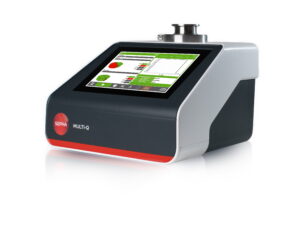
Vacuum Decay testing requires specialized instruments, controlled environments, and trained operators. Purchasing, installing, and qualifying this equipment in-house represents a significant capital and time commitment — particularly for organizations with limited test volume or those in early-stage development.
WESTPAK provides immediate access to validated, calibrated Vacuum Decay systems on a per-project basis, eliminating the need for internal procurement, IQ/OQ/PQ, and ongoing maintenance and calibration.
Regulatory-Aligned Testing and Documentation
Regulatory agencies increasingly expect manufacturers to justify their choice of CCI method and demonstrate that it is suitable for the specific container-product combination. WESTPAK delivers documented, defensible test data aligned with ASTM F2338.
Our team supports the full testing lifecycle, including:
- Sensitivity and specificity studies
- Method development for new container formats
- Batch release
High-Sensitivity Leak Detection for Sterile Products
Sterile pharmaceutical products — including biologics, sterile injectables, and combination devices — require CCI methods sensitive enough to detect leaks at the micron level. Traditional probabilistic methods often lack the sensitivity to identify microleaks that can compromise sterility over a product’s shelf life.
WESTPAK’s Vacuum Decay testing detects pressure changes indicative of leaks that dye ingress, bubble emission, and other legacy methods cannot reliably identify, supporting both product safety and sterility assurance claims.
Preserve Product — Eliminate Destructive Testing
Destructive CCI methods require sacrificing finished units from every production lot. For high-value products — biologics, sterile injectables, clinical trial materials, and small-batch production runs — this loss is costly and sometimes untenable.
Because Vacuum Decay does not alter or damage the container or its contents, tested units can be returned to inventory or released for distribution, reducing waste and preserving limited supply.
Accelerate Testing Timelines
WESTPAK’s vacuum decay testing infrastructure supports fast turnaround to keep pace with production schedules, clinical trial timelines, and commercial launch demands.
Comprehensive Package Testing — Beyond CCIT
CCIT is often one component of a broader package validation program. WESTPAK offers a full range of testing services, so you can consolidate your testing with a single qualified lab:
- Package conditioning and distribution simulation testing
- ICH stability storage studies for pharmaceutical products
- Mechanical shock and vibration testing
- Seal strength testing
- Accelerated aging testing
Independent, Third-Party CCIT Lab Services & Testing
Data from an independent, accredited testing laboratory carries more weight in regulatory submissions and audits than internally generated results.
WESTPAK has served as a trusted third-party testing partner for pharmaceutical and medical device companies for over 40 years, providing objective, well-documented results that withstand regulatory scrutiny.
Method Development and Custom CCIT Support
Every container system presents unique testing challenges — differences in materials, closure design, headspace volume, and product characteristics all affect test method parameters. WESTPAK works collaboratively with your team to develop and validate a CCIT approach tailored to your specific package.
- Develop CCIT test specifications and acceptance criteria
- Select the appropriate test method and instrument configuration
- Perform feasibility and proof-of-concept studies
- Support pilot-stage, clinical-stage, and commercial-stage testing
- Bridge from legacy probabilistic methods to deterministic technologies
Who WESTPAK Supports with CCIT Services
Quality and Compliance Teams — Directors and managers of QA, QC, validation, and regulatory affairs who need defensible test data for submissions, audits, and quality system documentation.
Packaging and Engineering Teams — Packaging engineers and development managers responsible for designing, validating, and qualifying container-closure systems.
Manufacturing and Operations — Production managers, operations directors, and process engineers focused on throughput, batch release efficiency, and reducing product waste during testing.
Laboratory and Technical Specialists — Scientists, CCIT specialists, and method development engineers who perform or oversee testing, feasibility studies, and validation protocols.
Why Choose WESTPAK for CCIT Services
- Over 40 years of package testing experience across regulated industries
- Extensive work with pharmaceutical, biologic, and medical device companies
- Consultative approach — we work as an extension of your team, not just a testing vendor
- Responsive turnaround aligned with your project timeline
- Experienced technical staff with deep knowledge of CCIT methods and regulatory expectations
HAVE A QUESTION?

If you have any questions or are not sure where to start, our Westpak experts are here to help!
Ask an ExpertWhether you're evaluating deterministic CCI methods for the first time or transitioning from legacy testing, WESTPAK can help you develop a testing plan aligned with your regulatory and production requirements.
Request a Quote